
Hands-On Commercial Roof Inspection in Cedar Rapids, IA
Rust staining beneath a displaced edge-metal joint raises a connected inspection question: whether water has passed behind the metal and affected the fastening or substrate that holds the perimeter together. A photograph of the stain identifies the location, but a hands-on examination can assess the adjoining connection and the limits of accessible evidence. Commercial Roofing Cedar Rapids inspects commercial roofs in Cedar Rapids, IA, to explain those physical relationships before recommending work. We follow an observed defect into the parts whose condition changes the repair.
An inspection serves a specific building decision, such as preparing a repair scope, investigating a change after a storm or assessing a roof before an alteration. We establish that purpose with the facility director, then examine the roof areas and details that can affect it. The result should distinguish a present defect, a developing maintenance concern and an unresolved concealed condition. Those distinctions keep a visible problem from being treated as evidence about layers that have not been examined.
Perimeter connection: Looking behind the visible displacement
Edge metal, coping and vertical terminations connect the roof to the building boundary. We examine movement, open joints, loose components and the membrane transition beneath or beside them, including the available fastening condition where it can be seen. A bent cover may have a different consequence from a loosened attachment, and both differ from a membrane that has pulled away below intact metal. The inspection identifies which adjoining component needs further examination before perimeter rebuilding is defined.
The August 10, 2020 derecho damaged businesses and apartments in southwest Cedar Rapids. For an owner requesting inspection after reported wind exposure, we examine the perimeter and equipment interfaces alongside field seams and attachment indications. The current physical findings guide that examination. A roof may have an obvious displaced component, a subtle separation beneath it or an unrelated pre-existing defect; describing those observations separately gives the director a clearer basis for the next repair or design investigation.
Water route: Reading the field between outlets
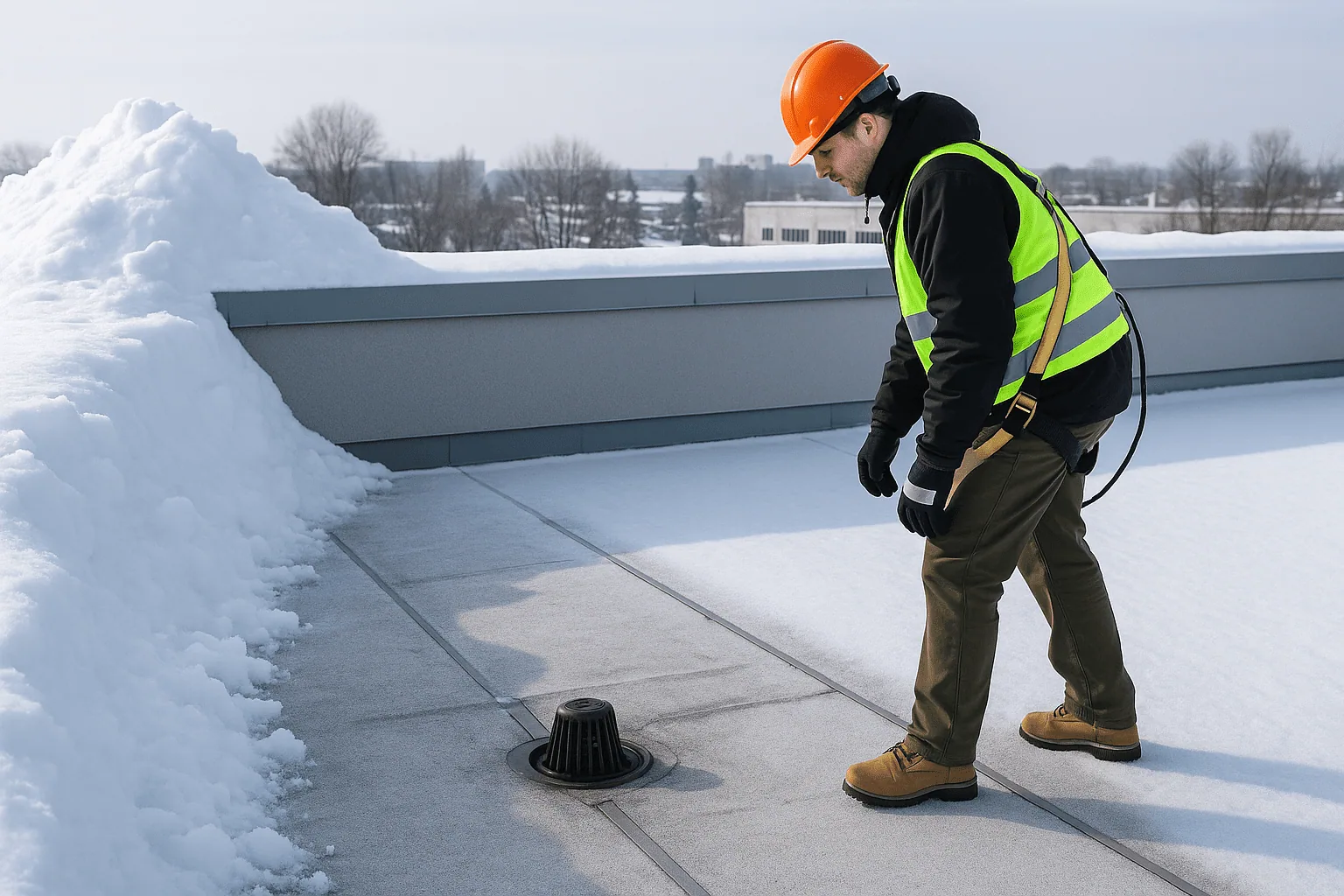
Debris collected at one side of a drain can reveal where runoff approaches it, while staining or compressed material may suggest a low area that needs closer assessment. We examine drains, scuppers, overflow provisions and the field geometry around equipment. An outlet that appears open at its inlet can still have a connection or piping issue beyond the visible roof surface. We identify what has been observed and when further drainage evaluation is necessary instead of assuming that an open-looking drain completes the assessment.
Water retention also affects how we evaluate seams and penetrations nearby. A membrane lap in a persistently wet depression has a different exposure from a similar lap on a freely draining field. We connect standing-water findings to the adjacent details and supporting layers, then explain whether clearing debris, correcting an approach or investigating underlying displacement is the useful next step. Inspection of the water route is therefore part of assessing the roof's connections rather than a separate housekeeping comment.
Sheet and detail: Finding the defect's actual form
A crease beside a curb may be movement in the sheet, a split through the weathering material or a symptom of inadequate support beneath it. We examine the membrane, seams and flashing closely enough to distinguish those forms where access permits. We consider prior repairs and material compatibility, because an old patch can obscure a lap or introduce another connection that needs assessment. A surface mark is described as a mark until examination supports a more specific conclusion.
On modified-bitumen roofing, layer continuity and lap condition require a different examination from a welded single-ply seam. We identify the system before selecting checks or recommending a repair method. Probing and opening are controlled activities that need to suit the material and inspection purpose; careless examination can itself damage a sound detail. Where an existing covering cannot reveal the condition beneath it, we propose the additional investigation that would change the repair decision.
Concealed layers: Choosing the next investigation
A roof can show limited surface distress while containing moisture or deterioration below the membrane. The hands-on inspection identifies indications and construction relationships, but concealed material may require an opening or another method to establish its condition. We explain where that information matters: a softened repair area, a proposed recover or suspected wet material around recurring leaks. Thermal mapping and selected core checks can then be considered for the particular assembly.
On a large or difficult-to-access roof, overhead imaging may help orient visible conditions and identify areas needing closer examination. The image record and hands-on findings answer different questions, so we relate them rather than allowing the photograph to stand in for touch, measurement or an opening. Restricted areas are identified in the inspection results, with their effect on the owner's intended decision. The next step should resolve a meaningful uncertainty, not simply add another method to the visit.
Building activity: Access that changes the examination
Hiawatha and Nixon elementary schools are in Hiawatha within the Cedar Rapids school district. For a requested school-property inspection, secure access and the activities beneath equipment or roof openings can limit how the examination proceeds. We discuss those restrictions with the facility contact, keeping the investigation tied to the actual building and its accessible details. Inspection work in Hiawatha uses that operating information to distinguish an inaccessible area from one that has been examined and found serviceable.
Cedar Rapids' grain-processing industry also makes production restrictions a relevant question at an industrial inspection. Where the requested facility has air-intake controls, process exhaust or areas sensitive to dust, we plan the roof examination around those actual conditions. A close look at a penetration may require trade coordination or a limited shutdown if the equipment prevents safe access. Those constraints affect the evidence obtained, and the report should identify them beside the related finding.
Marion Enterprise Center contains multiple industrial parcels. On a requested building there, inspection access near active loading areas needs coordination so that the roof examination does not interrupt vehicle movement below.
Action record: Turning observations into a repair choice
A condition photograph becomes useful when it is located on the roof and paired with an explanation of the defect and its consequence. We prepare written findings with photographs that distinguish recommended repair, maintenance and further investigation. A facility director can then see which observations affect immediate water exposure and which belong in later planning. The report identifies the part needing attention, the adjoining material involved and the practical information still required before the work is defined.
We also consider whether a proposed repair can be bounded within otherwise serviceable roofing. Several unrelated visible defects may need separate local interventions, while a repeated attachment or moisture issue may justify wider evaluation. The inspection connects those patterns to the roof's construction rather than presenting every mark as an isolated task. That relationship helps establish a sensible intervention sequence and prevents a maintenance recommendation from being mistaken for a full assessment of concealed structural condition.
Commercial Roofing Questions
Can an inspection tell us whether a proposed recover is suitable?
Visible findings and construction information can establish questions that a recover proposal must resolve. The condition of retained layers, roof-covering count and deck support may still require openings or testing. We identify those needs and separate an initial visual assessment from the additional evidence needed to accept the existing assembly.
Will you disturb every old patch during the inspection?
The information needed from each detail controls the examination. A stable repair may be assessed without removal, while a loose or obscuring patch may need a planned opening if its condition changes the proposed work. We discuss intrusive examination and suitable close-in before disturbing the existing water barrier.
How are inaccessible areas handled in the findings?
A restricted area is identified with the reason it could not be examined and the effect on the requested assessment. We can discuss another access method or a coordinated return where the missing information matters. It should remain distinguishable from an inspected area that showed no visible defect.
Does the inspection include a structural certification?
Roofing observations can reveal deterioration or movement that needs structural evaluation, but they do not replace that professional assessment. We identify the concern and coordinate the appropriate review where necessary. The roofing recommendations then follow the support conditions established for the intended repair or replacement.
Related Pages
Request a roof assessment or call 555-555-5555.
Questions? Call Us
Free roof assessment