
Infrared Commercial Roof Moisture Survey in Cedar Rapids, IA
Insulation wetted beneath a closed membrane can change the way the roof releases stored heat after daytime warming, leaving a surface-temperature pattern that differs from the adjoining assembly. That difference can direct an investigation, but it needs interpretation before it becomes a removal boundary. Commercial Roofing Cedar Rapids combines infrared observations with targeted checks for commercial roofs in Cedar Rapids, IA, where concealed moisture affects a repair, recover or replacement decision. We examine what the thermal pattern means in the roof's actual construction.
The investigation follows a physical sequence: suitable observation conditions, a located temperature pattern, an explanation of possible construction effects and confirmation where the result changes the work. A camera does not directly measure water inside the insulation. We use its observations to choose useful examination points, then relate the findings to the layers that would remain or be removed. The facility director can see where concealed condition has been established and where uncertainty still affects the proposed intervention.
Heat release: Conditions that make the observation useful
A suitable roof must develop a temperature difference that can be observed under the chosen survey conditions. Recent weather, solar heating, wind, rain and surface moisture influence that difference, while insulation and covering materials affect how it appears. We assess the assembly and observation window before proceeding. A roof that has not experienced useful heating, or one with surface water masking the pattern, may need a different time or investigation method rather than a forced interpretation of weak thermal contrast.
The Cedar Rapids airport's 1991-2020 normals show a July daily maximum of 82.8 F and a January maximum of 27.9 F. Those station normals describe seasonal context, while actual survey-day heating and cooling govern the usable observation window. We evaluate the conditions at the requested building and the surface being examined, including shaded sections or areas sheltered by equipment. The useful distinction is between an observed pattern produced under adequate conditions and an area whose lack of contrast cannot answer the moisture question.
Construction differences: Other reasons a surface can look warmer
A changed insulation thickness, an earlier repair, a different deck arrangement or equipment heat can produce a temperature pattern without demonstrating moisture in the roofing. We relate thermal observations to the building's construction phases and known alterations, then compare visible features at the same locations. A rectangular warm area following an old addition line needs a different investigation from an irregular pattern spreading outward from a failed drain connection. The shape helps frame the question, but it does not resolve it.
We also consider surface differences, shading and heat discharged by rooftop equipment. On a requested manufacturing roof with operating process equipment, those conditions may complicate interpretation or change the useful survey window. Cedar Rapids' grain-processing industry makes equipment and production restrictions relevant questions for local industrial work. We discuss the actual operation before deciding how a manufacturing-property survey can separate roof condition from temperature effects associated with the equipment.
Core examination: Connecting the image to the layers
A targeted opening can establish the materials at a thermal indication and examine their condition directly. We choose check locations that can resolve the suspected pattern, compare them with other areas where appropriate and document the observed layers. The opening also needs a compatible close-in method, because an investigation should not leave a new water-entry route behind it. We coordinate intrusive work with the facility contact and any relevant existing-roof requirements before cutting through the covering.
Where a check identifies wet material, we consider how that finding relates to the adjoining pattern and the roof's construction. A dry result may reveal a different explanation or call for another check, rather than allowing the image to overrule the physical evidence. Direct examination of visible details can then connect concealed moisture to a likely defective junction. The investigation builds a located account of condition, with the strength and limits of the evidence carried into the proposed removal area.
Wet extent: Defining a repair that reaches suitable material
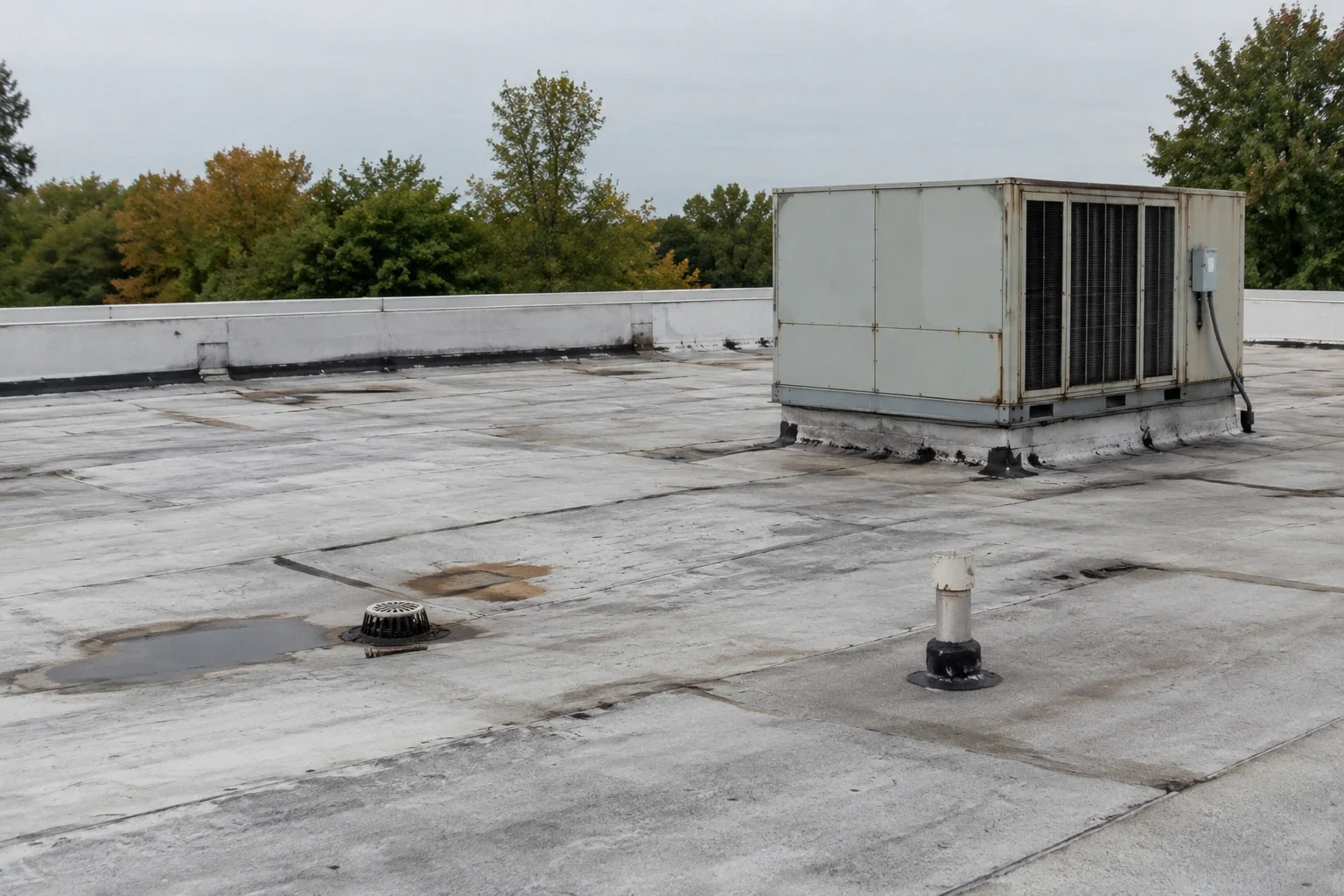
A repair over wet insulation may close the membrane while retaining softened support beneath the new detail. Moisture mapping helps identify where that concealed condition needs further confirmation before a bounded roof repair is selected. We relate the suspect area to drains, seams and construction changes, then establish the material condition at the proposed repair edge. The line drawn on an image becomes useful only when the adjoining assembly can provide a suitable rebuilding connection.
That boundary can change as removal exposes additional affected layers. We explain the findings used to establish the initial scope and the conditions that would require extending it during work. A recover proposal needs particular attention to any wet material that would otherwise remain beneath the new covering. Where moisture is widespread or the retained construction is unreliable, full removal and replacement may offer a more workable rebuilding route than many scattered openings.
Building access: Arranging checks above active rooms
Czech Village and New Bohemia combine small businesses, entertainment venues and multifamily housing. For a requested building with several occupied uses, core-check locations and close-in work may need to avoid a sensitive room or coordinate access with more than one occupant. We discuss those restrictions before choosing examination points, keeping the locations relevant to the thermal question. Moisture investigation in the district therefore includes the activity beneath the opening as well as the material above it.
Marion Enterprise Center has multiple industrial parcels beside U.S. 151 and Iowa 13. At a requested industrial building there, loading routes, equipment operation and restricted production areas can influence when observation and confirmatory work proceed. We plan the survey window and direct access together so that the thermal record can be tied to suitable checks. A useful observation obtained without a workable route for confirmation may leave the facility director unable to resolve the condition that changes the roof scope.
Restoration choice: Using the findings without overstating them
A located moisture finding helps define removal, but it is only one part of the roof decision. Attachment, drainage, flashing height and deck condition can still make a proposed intervention unsuitable. We combine the concealed-layer findings with those adjoining requirements and explain the restoring sequence: remove affected roofing, address unsuitable support, reinstate the necessary layers and connect the weathering detail to the remaining assembly. The survey informs that work rather than replacing the examination needed at each rebuilding junction.
We provide written observations and located photographs that distinguish thermal indications, confirmation points and recommended additional investigation. The owner can use them to plan an intervention and understand the areas where concealed material remains unresolved. Follow-up maintenance should also examine the water-entry defect associated with the wet area, because removing insulation without restoring the broken connection leaves the same route available to the next rainfall. The useful outcome is a repair choice tied to both moisture extent and its adjoining cause.
Commercial Roofing Questions
Does every warm area on the infrared image need removal?
The physical explanation and confirmatory findings decide what the pattern means. Construction changes, equipment heat and surface differences can produce thermal contrast without wet insulation. We compare the observed pattern with the roof's arrangement and examine suitable points before translating it into a removal recommendation.
Can the survey proceed just after rain?
Surface moisture and recent weather may prevent useful temperature contrast or obscure its meaning. We assess the assembly and conditions before choosing the observation window. Another time or method may be needed when the roof cannot produce a reliable pattern, rather than treating an inconclusive image as evidence that the insulation is dry.
How will core openings be closed after the investigation?
Each planned opening needs a suitable repair method for the existing material and assembly. We arrange access and close-in before intrusive work, then restore the weathering connection after the check. The size and position of the opening also need to support the investigation without unnecessarily disturbing an adjoining detail.
Could the findings support replacement of only one roof section?
Separate construction and a suitable transition can make sectional work practical where the affected area is bounded. We assess wet extent together with attachment, drainage and the connection to retained roofing. A localized thermal pattern alone does not establish a workable sectional replacement unless those adjoining conditions can also be resolved.
Related Pages
Request a roof assessment or call 555-555-5555.
Questions? Call Us
Free roof assessment