
Commercial Roof Insulation and Cover Board in Cedar Rapids, IA
A cover-board joint that has lost support can leave the membrane flexing over a discontinuity instead of resting on a stable layer. Traffic or repeated movement at that location may then stress the sheet and its nearby connections. Commercial Roofing Cedar Rapids examines insulation and cover board in Cedar Rapids, IA, as working parts of the commercial roof assembly, not simply thickness below the covering. We identify the support, moisture and attachment conditions that govern how those layers should be retained or rebuilt.
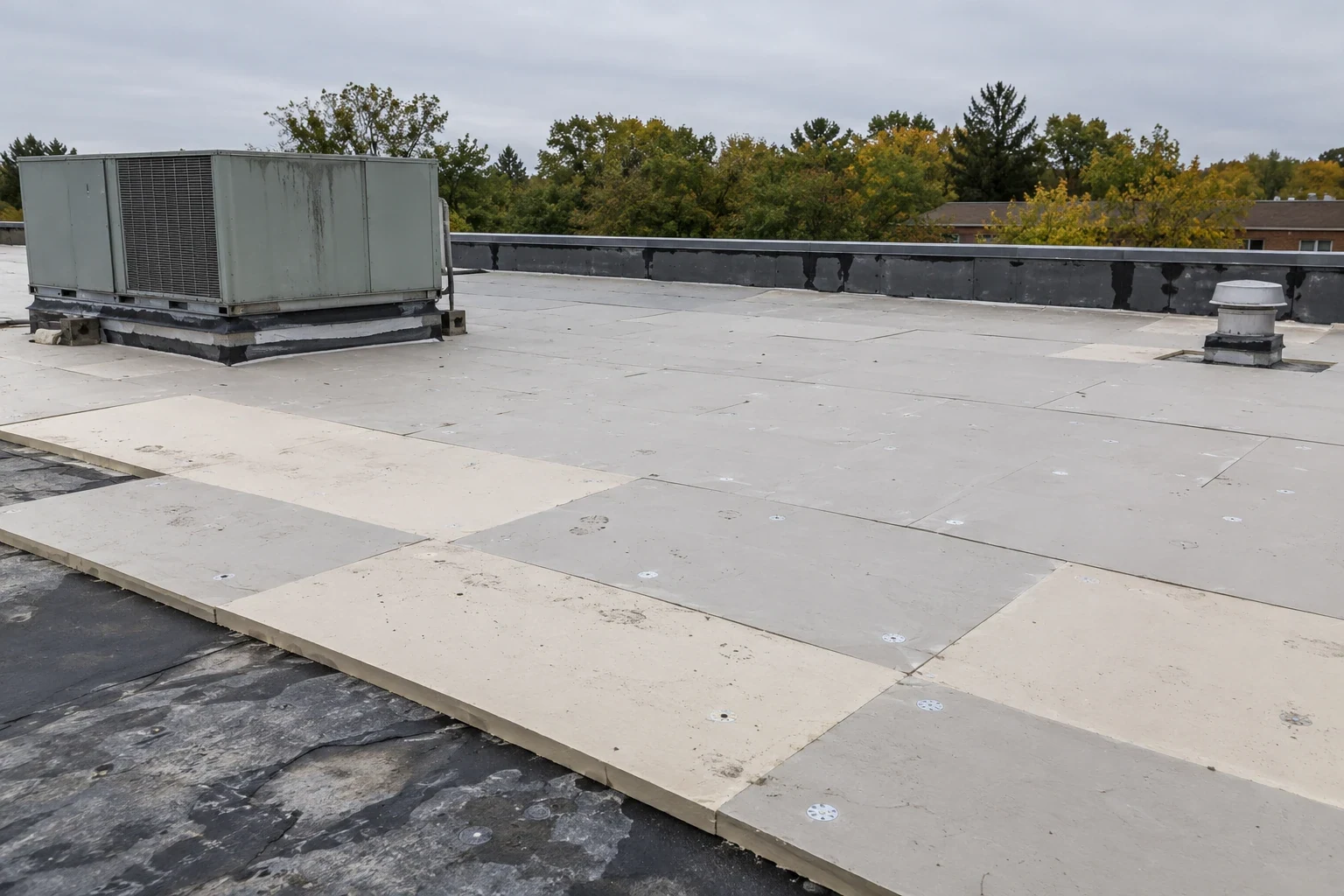
Insulation contributes thermal performance and may form drainage slope, while cover board provides a receiving layer suited to the selected roof system. Each material must fit its place in the assembly and the method connecting the roof to the deck. A damaged layer can require localized rebuilding beneath a repair, while a new roof may need a complete insulation and cover-board arrangement. The choice follows the construction and defect rather than treating additional thickness as a universal correction.
Receiving layer: Understanding the discontinuity beneath the sheet
A membrane can show a wrinkle or wear line where supporting material has moved, separated or compressed. We examine the visible condition and investigate the layers beneath where the findings affect the work. Board arrangement, joints, attachment and the deck's shape can each contribute to the relationship. Replacing a sheet over the same unsupported area may leave it carrying the same stress. The repair must address the physical base before the weathering material is closed.
Different cover boards provide different properties and installation requirements, so selection needs the roof system and intended exposure. We consider compatibility, support, fastening or adhesion and the conditions around equipment traffic. A PVC roof assembly needs an appropriate receiving arrangement rather than a board chosen independently of the membrane. The complete system also has design requirements for attachment and performance, with the deck and lower insulation included in that connected review.
Wet material: Defining where retained layers stop
Insulation affected by water can lose useful performance or become unsuitable as support within the assembly. A visible leak may reveal the entry point without showing the full wet extent. We investigate where concealed condition changes the rebuilding scope, using moisture indications and selected openings where appropriate. The findings identify which layers are affected and where a stable, dry receiving boundary can be established, rather than assuming that removal only beneath the visible defect is enough.
The reinstated layers need a suitable transition to the surrounding retained construction. An abrupt thickness difference can affect membrane support or create a low area, so we consider the repair's shape together with its materials. Attachment or adhesion also has to fit the new and retained arrangement. Where wet material extends across much of the roof, the proposal may need wider removal. Closing the covering should follow resolution of those supporting-layer conditions at the actual repair boundary.
Tapered arrangement: Connecting drainage to detail height
Tapered insulation can direct water toward outlets or shape a route around equipment, but the proposed slope needs the roof's measured elevations and discharge arrangement. We examine low areas, drains and scuppers before selecting the shape. Drainage-connection work may be necessary where an outlet's relationship to the field prevents useful runoff. Raising an area without resolving its destination can move retention to another detail rather than correct the original route.
The added thickness changes curb, flashing and perimeter relationships as well. We assess those junctions during the proposal so that an improved slope does not leave inadequate vertical connection or obstruct equipment service. A cricket behind a curb needs to join the adjoining field without trapping water at its ends. The tapered arrangement and cover-board placement should provide continuous support while preserving the heights and transitions required by the finished roof system.
Layer connection: Carrying the assembly into the deck
A mechanically attached system needs suitable fastening through its actual layers into the deck, while an adhered arrangement needs compatible receiving surfaces and attachment at the necessary interfaces. We consider those connections together, checking whether lower layers remain reliable and whether the proposed system fits the substrate. Deck deterioration or uncertain fastening support can require additional assessment before the assembly is closed. A stable-looking cover board alone cannot establish the strength of the entire connection path.
For retained roofing beneath a recover, existing insulation and coverings become part of that examination. We identify construction changes, wet areas and unsuitable material that must be removed before new layers are installed. Where full roof replacement is selected, exposed construction permits the rebuilding to begin from an appropriate receiving base. The method follows the deck, attachment requirements and material compatibility of the complete system rather than the convenience of leaving another layer in place.
Thermal and code needs: Establishing the project's arrangement
Cedar Rapids' construction-code information identifies a 2024 IBC amendment. Iowa's state-adopted code list includes the 2012 IECC, while jurisdiction and the proposed alteration determine the requirements for the particular project. We establish that review before finalizing insulation changes, including the relevant energy requirements and local amendments. The new arrangement should fit the building's required thermal performance together with its attachment and drainage needs rather than satisfying one requirement at the expense of an adjoining detail.
Insulation position can also interact with air and vapor control within a roof assembly. Building use, interior conditions and existing layers need consideration where condensation or an altered arrangement is involved. We discuss the available information and coordinate suitable design input when the proposed work requires it. A roof suffering concealed moisture needs its entry or condensation question understood before new insulation is installed, because replacement material alone does not eliminate the route that wetted its predecessor.
Industrial work areas: Rebuilding support beside production
M&S Manufacturing operates a precision-machining facility in Monticello. On a requested industrial roof in Monticello, equipment service and concentrated traffic may influence the receiving-layer choice and protection around the work. We examine those actual conditions with the facility director, coordinating removal and daily close-in above sensitive activity. The insulation and cover-board assembly must suit its operating exposure as well as its material connection to the new weathering layer.
Anamosa is served by U.S. 151 and Iowa 64 and includes public-school and county-government functions. A requested institutional or commercial property there may need work phased beside occupied rooms and service routes. We identify which layers will be opened, the protection needed beneath them and the section that can be rebuilt within the available window. The finished work should leave suitable support and an accessible drainage route, with adjoining concerns identified before another roof section is opened.
Commercial Roofing Questions
Can a cover board hide compressed insulation underneath it?
Lower-layer condition decides whether the arrangement can provide suitable support. A new board may span a visible irregularity without correcting unstable material beneath it. We examine the affected insulation and attachment, then remove or rebuild unsuitable layers before selecting the receiving board and membrane connection.
Will tapered insulation require our equipment curbs to change?
The finished field elevation must be compared with each curb's flashing height and service arrangement. Added slope can reduce usable vertical connection or alter the drainage route beside equipment. We assess those relationships together and include necessary detail work before committing to the tapered shape.
Why are insulation and fastening considered in the same scope?
The roof's load path crosses those layers before reaching the deck. Thickness, material condition and attachment method therefore influence the connection needed for the complete assembly. We establish the proposed arrangement and suitable deck support rather than selecting insulation independently of how the roof will be secured.
What happens if removal exposes a different assembly from the records?
The physical construction needs to be assessed before new layers close over it. We identify the difference, examine its effect on support, moisture and attachment, and revise the rebuilding where necessary. The replacement arrangement must fit the material actually present rather than preserve a specification based on an incorrect existing detail.
Related Pages
Request a roof assessment or call 555-555-5555.
Questions? Call Us
Free roof assessment