
Johns Manville Commercial Roofing in Cedar Rapids, IA
The insulation edge below a roof drain can settle while its membrane flange stays in place, leaving a low approach where water holds at the connection. Replacing exposed sheet without restoring support leaves the detail vulnerable to the same movement. Commercial Roofing Cedar Rapids assesses Johns Manville assemblies in Cedar Rapids, IA, by tracing water through membrane, flashing and receiving layers. The installed JM system and condition beneath it determine whether work stays at one outlet or extends into the field.
Johns Manville makes TPO, PVC and EPDM single-ply systems, APP and SBS modified bitumen, built-up roofing, insulation and cover boards. They do not share one repair procedure. We identify material, attachment and prior repairs before matching a connection. Firm support can accept localized work; wet or unstable layers may require a larger scope.
Material distinction: Identifying the JM system at the exposed edge
Thermoplastic sheet, rubber membrane and asphalt-based roofing meet details differently. We examine seams, markings, flashings and records before selecting replacement components. JM TPO and PVC seams are welded; EPDM uses other seam materials and preparation; modified bitumen and built-up roofs rely on layered surfacing. An older record does not settle what remains after later repairs.
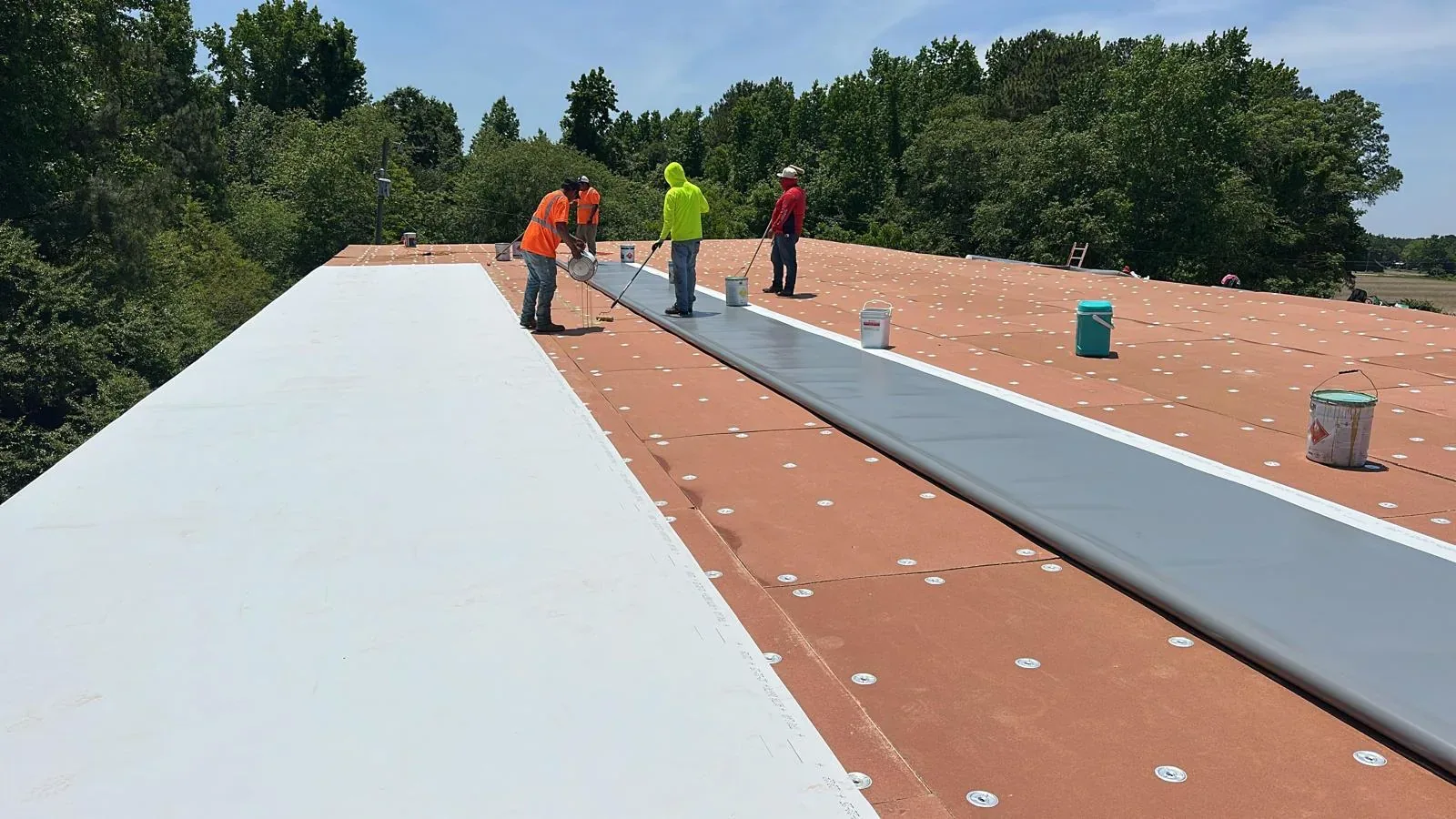
Johns Manville describes its TPO as polyester-reinforced and formulated for flexibility and weldability. That informs a repair only when the installed membrane and receiving surface match. TPO assembly work follows welded sheet and support. JM also offers EPDM, PVC, APP, SBS and BUR, so one detail is not carried across unlike roofs.
Old coating or a patch can obscure the membrane. We inspect a limited area where preparation changes the selection and confirm the edge can receive a new connection. Carlisle SynTec assemblies and Holcim Elevate systems need their own material identification.
Drain approach: Restoring the support around an outlet
A low spot can follow compressed insulation, a deck change or a shifted flange. We trace the field into the sump, checking the clamp and discharge route. A new flange can be sound while insulation still holds water against it, so geometry and support matter with the visible connection.
If the membrane has pulled away, repair material must suit the JM assembly. We assess retained layers, rebuild support where needed and restore the flange before closing the field. Drain and scupper repair includes clamping components and discharge. A separate sump or deck correction is completed before sealing.
Water after a storm does not identify the failed layer. We compare standing water with interior symptoms and prior repairs. A focused opening can show whether a bounded tie-in is supportable. The final surface must drain and leave the outlet accessible.
Below the membrane: Setting the removal edge from actual condition
Wet insulation, damaged cover board or a loose deck can keep a drain repair from holding. We inspect exposed layers and nearby areas indicated by the opening or interior report. Material stays only if it can support the proposed assembly. The boundary follows observed condition rather than one stain or an unverified broad area.
At a requested Marion property, the deck and insulation must be opened and inspected before a JM section can tie into retained roofing. Nearby development and utility service do not establish the construction of that individual building; the exposed layers set the removal boundary. Cover-board reconstruction restores support where those layers have failed.
Repeated work around several outlets may justify comparing localized repair with broader removal. Full replacement can reset drainage and flashing together when the surrounding field cannot support a narrower scope.
Cold-season exposure: Protecting outlet connections and close-in
Spotters northeast of Cedar Rapids reported 11.5 inches of snow January 9, 2024, and 11.6 inches at another point the next morning. The two reports apply only to their separate observation points; neither sets a citywide depth or a roof-load calculation. On the requested building, snow and freeze-thaw exposure make drains, laps and close-in worth checking where water has entered. The roof's condition and project design govern the work.
Outlet work needs a weather window. We stage replacement insulation and flashing before opening the assembly and protect the exposed area. A temporary cover does not correct the drain. The membrane must connect securely to the outlet and surrounding JM sheet with support rebuilt first. EPDM work uses different seam and flashing requirements from thermoplastic roofing.
Weather affects welding and surface preparation. We limit exposure above occupied space and review the drain, lap and discharge route together at closeout.
Regional industrial buildings: Coordinating around access and production
M&S Manufacturing has an 89,000-square-foot precision-machining facility in Monticello. That figure is floor area, not roof area, and does not describe another building. Near Monticello, equipment discharge, delivery access and the operation below influence staging. We inspect the actual roof, note restricted routes and protect the work area before removal.
Cedar Rapids economic development identifies I-380, I-80, U.S. 30 and U.S. 151 as goods-movement routes, with rail serving businesses. Those routes affect material delivery, while each property determines staging. Where water reaches occupied areas, occupied-building planning coordinates protection and close-in with installation.
We document the exposed flange, lower layers and retained JM boundary. At closeout, the facility representative sees why insulation, sheet or attachment work was included and which separate maintenance item remains.
Restoration sequence: Reconnecting the outlet to a sound field
Once removal reaches suitable support, we rebuild insulation and cover material to the planned drain geometry. The flange is prepared for the JM membrane, then new sheet joins retained roofing through compatible materials. Corners and transitions are completed before the field closes. A needed sump or deck correction is made while the connection remains accessible.
Fasteners, adhesives and cover board are considered with the outlet termination. We review the finished connection and runoff path, then record any restriction or maintenance item. That record preserves the removal boundary and shows how the detail can be inspected later.
If the existing assembly cannot receive the selected JM system, we compare options using attachment, deck, insulation, height, drainage and project requirements. The choice is made before ordering so close-in and material delivery remain coordinated.
Where the facility needs operations to continue below the repair, we separate removal, lower-layer replacement and membrane closure into workable sections. This keeps temporary protection aligned with the amount open and provides a clear point for checking the drain detail before the next area begins. Equipment access and discharge protection are included when they affect the connection or the finished water route.
Commercial Roofing Questions
Does a JM system name tell you whether a drain can be repaired?
The system identifies a starting point, but the drain flange, membrane, support and outlet path determine the repair. We confirm the installed material and inspect the surrounding layers before choosing a compatible connection or setting a wider replacement boundary.
What makes a drain-area patch expand into insulation removal?
Soft, wet or compressed insulation can leave the new flange without firm support and retain water beneath the membrane. We inspect the exposed layers and extend removal only where the condition requires a sound receiving base for the replacement roof detail.
Can Johns Manville roofing use the same repair detail across TPO and EPDM?
The materials join differently. TPO is heat-welded, while EPDM uses compatible seam and flashing materials. We identify the actual roof and use the product requirements for that assembly rather than transfer a repair detail between unlike membranes.
How do you plan outlet work during snow season?
The opening size, forecast, material preparation and building operation set the close-in sequence. We stage the compatible membrane and replacement layers first, protect the exposed area while work proceeds and verify the drain connection and discharge route before handback.
Related Pages
Request a roof assessment or call 555-555-5555.

Questions? Call Us
Free roof assessment